
One Health: connecting human, animal, plant, and environmental biology

One Health at Cambridge brings together researchers across human, animal, plant and environmental systems to address some of the most urgent global health challenges, including emerging infectious diseases, antimicrobial resistance, and the impacts of climate and environmental change on health. What distinguishes Cambridge is our unique integration of cross-disciplinary research with clinical, veterinary and in-field expertise, enabling insights to move seamlessly from fundamental discovery to real-world application.
Why One Health matters
Global health challenges are increasingly interconnected:
- Many emerging infections are zoonotic, moving between animals and humans
- Antimicrobial resistance spans clinical, agricultural, and environmental settings
- Climate change is reshaping disease patterns, vector distribution, and food security
- Ecosystem disruption can increase the risk of pathogen spillover
- Vaccines and future therapeutic strategies must intersect with these challenges
Addressing Global Health at scale requires coordinated approaches that cross traditional disciplinary boundaries. One Health at Cambridge provides a valuable framework for driving a step change in this important research area.
By combining approaches spanning genomics, modelling, laboratory science and field research, Cambridge is advancing a more connected understanding of global health, recognising that the wellbeing of people is inseparable from the health of animals, ecosystems and food systems.
Why Cambridge
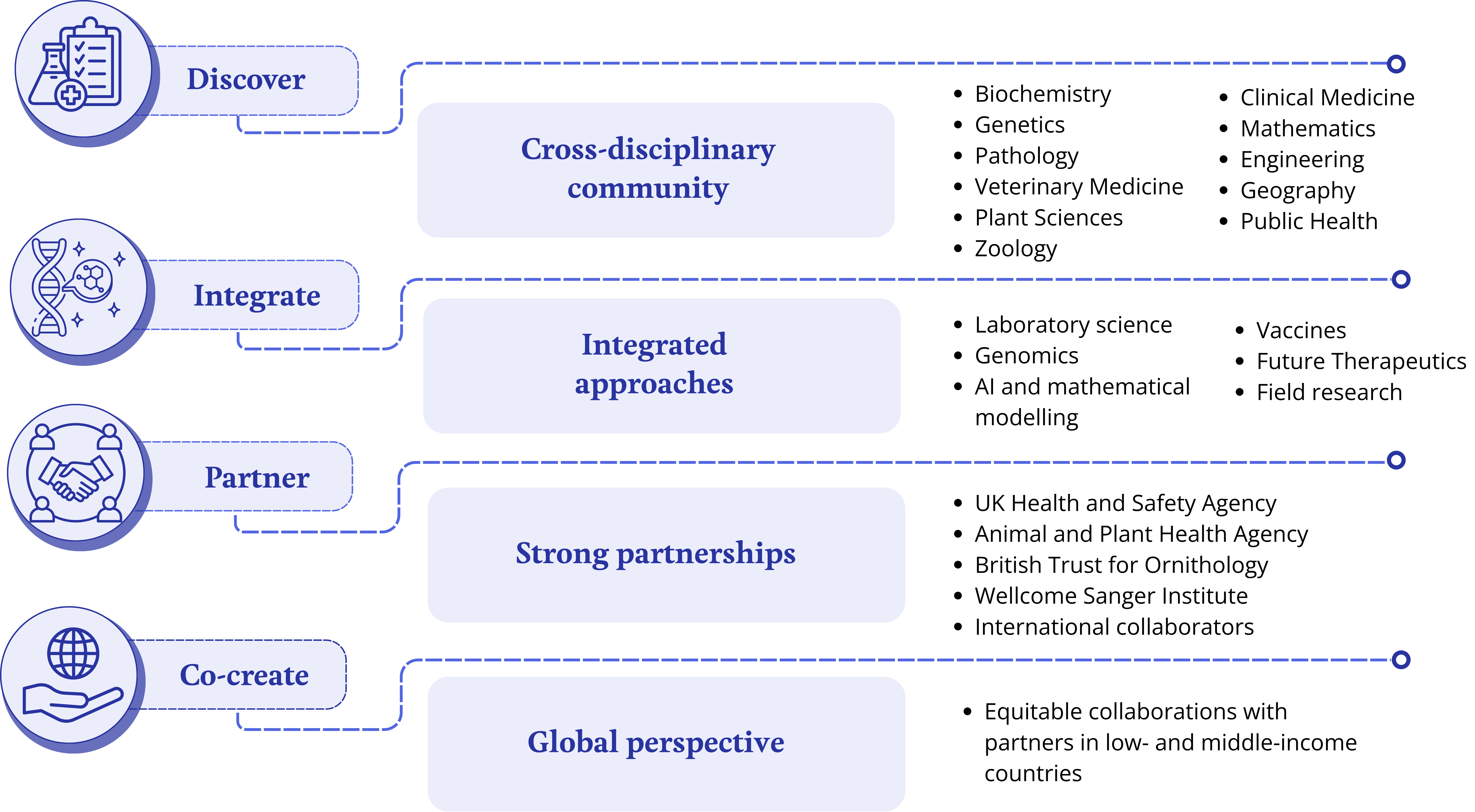
Cambridge brings together an extraordinary range of expertise across the biological, clinical, environmental, and quantitative sciences. Its cross‑disciplinary community spans departments such as Biochemistry, Genetics, Pathology, Veterinary Medicine, Plant Sciences, and Zoology, as well as Medicine, Mathematics, Engineering, Geography, Public Health, and others.
Researchers work through integrated approaches that blend laboratory science, genomics, fieldwork, artificial intelligence, and mathematical modelling. Cambridge also benefits from strong partnerships with organisations including the UK Health Security Agency (UKHSA), Animal and Plant Health Agency, British Trust for Ornithology, the Wellcome Sanger Institute, and numerous international collaborators.
This work is grounded in a global perspective, supported by long‑standing and equitable collaborations with partners in low‑ and middle‑income countries.
Our Research Areas

Changing Pathogens in a Changing World
Cambridge researchers are investigating how pathogens evolve, spread and respond to environmental and societal change, integrating pathogen biology, host:pathogen interactions, genomics, epidemiology, modelling, and field studies.

Antimicrobial Resistance (AMR)
Research spans the emergence, transmission and control of antimicrobial resistance across clinical, agricultural, and environmental contexts, from molecular mechanisms to global policy.

Climate, ecosystems and health
Work in this area examines how environmental change, biodiversity loss and shifting ecosystems influence disease dynamics, vector ecology and pandemic risk.

Food systems and plant health
Research in plant sciences and agriculture contributes to One Health by addressing crop resilience, plant-pathogen interactions, and the links between food security, nutrition and global health.
Building the future of One Health
One Health at Cambridge is an active and growing research community. By connecting expertise across disciplines and sectors, the University is well positioned to address emerging challenges, identify critical research gaps, and develop new collaborations and partnerships.
To explore opportunities to work together, please contact:
Dr Abi Herrmann, Research Strategy Manager
To learn more about supporting this vital research, please contact:
Holly Singlehurst, Associate Director, Biological Sciences
Cambridge University Development and Alumni Relations Office